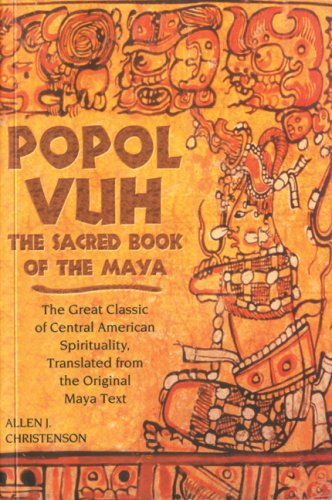
 The Popol Vuh is the most important example of Maya literature to have survived the Spanish conquest. It is also one of the world's great creation accounts, comparable to the beauty and power of Genesis.
Illustrated with more than eighty drawings, photographs, and maps, Allen J. Christenson's authoritative version brings out the richness and elegance of this sublime work of literature, comparable to such epic masterpieces as the Ramayana and Mahabharata of India or the Iliad and Odyssey of Greece.
Customer Review: The Best
I agree with the last review. This is the best version of the Popol Vuh to date. Tedlock's is good but this translation, format, and over all presentation is excellent. The first review seems to have a case of the sour grapes!
Customer Review: From An Attentive Reader
It would be a shame to let the slipshod and factually inaccurate review (below) pass without correction and comment as this is an exciting new scholarly edition of the most important extant Maya text.
Even a cursory reading of the first page of the introduction (and throughout) would have supplied the information that the translator Christenson's primary Maya linguistic expertise is in Quiché (or K'iche'). And of course it would be extraordinarily foolhardy for anyone to attempt a translation of the Popol Vuh without a knowledge of the language in which the text is written.
This is not the place to rehearse the arguments regarding the purpose, practise and philosophy of translation - this has been done at great length by such well known commentators on the subject as Eco and Steiner not to mention the myriad even more technical writers. But the writer of the previous review passes judgement on the `accuracy' of the translation compared to that of Tedlock's readable and famously demotic version. One has to wonder how this judgement has been arrived at, and logically, what third, control element was used against which to compare the accuracy of the translations. Surely this would have had to have been the 16th century Quiché text which would, of course, require a knowledge of that language and it's historical orthography. It seems more likely that the reviewer simply compared the two translations; not much of a methodology. It would be a travesty if such an inadequate critique was allowed to stand unchallenged.
Fortunately the second volume of Christenson's edition (which the previous reviewer fails to mention) provides the exact tools necessary for the informed reader to make their own judgement by including a new and complete transcription of the original Quiché text (from the manuscript in the Newberry Library, Chicago) with a parallel literal English translation, something not available before, and making this a landmark edition of the Popol Vuh and essential for serious students of Maya culture and history.
Buy Now

0 comments:
Post a Comment