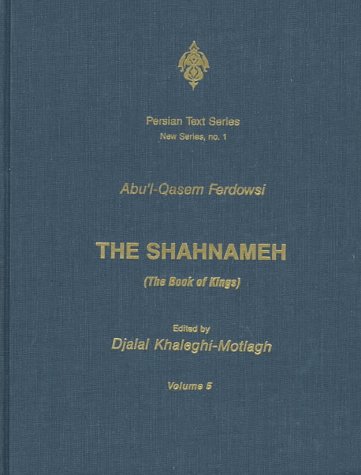
 The great national epic of Persia—the most complete English-language edition
Wherever Persian influence has spread, the stories of the Shahnameh become deeply embedded in the culture, as their appearance in such novels as The Kite Runner amply attests. Among the greatest works of world literature, this prodigious narrative, composed by the poet Ferdowsi in the late tenth century, tells the story of pre-Islamic Iran, beginning in the mythic time of creation and continuing forward to the Arab invasion in the seventh century. The sweep and psychological depth of the Shahnameh is nothing less than magnificent. Now one of the greatest translators of Persian poetry, Dick Davis, presents Ferdowsi’s masterpiece in an elegant combination of prose and verse.
Customer Review: Fairies, Demons and the Glory of Kings
Nobody has been very enthusiastic up till now, and so it must be up to me. I loved and adored this book. I was entranced from the very beginning. Who could resist a story that tells you, "He was like a tall cypress tree topped by the moon", or, "He gathered together fairies, leopards and lions"?
The "Shahnameh" or "Book of Kings" is one of the world's great epic poems; but the episodic structure, the frequent fantastic and supernatural elements, make it more like "Tales of King Arthur" than the "Iliad". The "Iliad" happens almost in real time; but the "Shahnameh" follows Iran's legendary Royal Line over centuries from its origins: the first Kings are culture-heroes who teach men the use of fire, metals, medicine, weaving.
Ancient epics crammed with unfamiliar names are not everyone's taste. For me, nothing beats these tales of a time when everything was bigger and brighter, as if the world had a childhood as well as individuals; when every morning was different and everything that happened was wondrous simply because it happened. This is poetry, concise and allusive, so stylised images replace gritty detail; psychological realism is absent and emotions are painted by numbers.
Fairy-tale colours and seething incident compensate for the absence of that large-scale architecture that draws you through the "Iliad". This book is very long, not repetitious but, let's say, uniform: it is all marzipan throughout. So don't be in a rush to finish it, pace yourself. Read a bit, leave it for a while and then come back to it.
The truth that remains behind, as with all epic poetry, is the Invincibility of Fate, and Transience: the illusoriness of what seemed most real... I could complain mildly: I find the prose a bit too flat and short-winded for this subject-matter; and I'm not convinced that occasional bursts of rhyming couplets add much. But that would border on ingratitude: this is a wonderful book. At last those of us too lazy to learn Farsi have some idea what the fuss was about.
Customer Review: Its ok
I bought 4 copies of this book for my daughter's teachers. I thought it would be a good item for them to remember her by(persian).
So, I did not read it, but did browse through it and read some sections. I love the translation. I am a little disappointed about the quality of the paper and binding. Also, I think there should have been some illustrations. Actually, I was expecting illustrations and there are none.
It seems to me this is just a cheap re-packaging of the much more expensive collection.
S.
Buy Now

0 comments:
Post a Comment